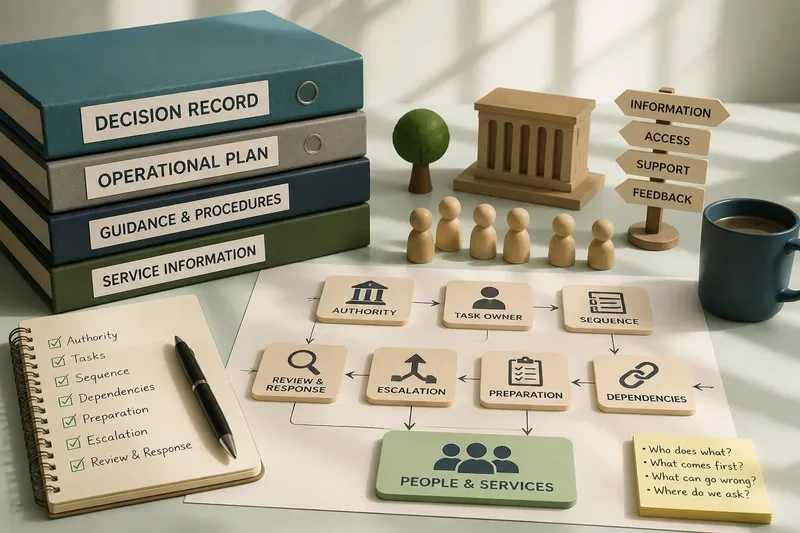
Before the Policy Brief: How the Public Memorandum Carries a Decision
See how a public memorandum carries a decision request, separates evidence from advice and leaves a clear record for readers who revisit the file.
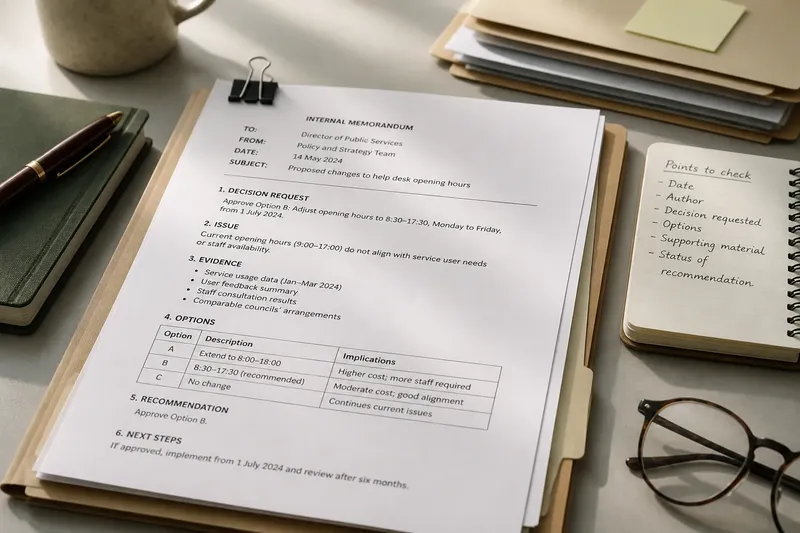
A public memorandum makes a decision request easier to follow across an administration. Its familiar shape—issue, evidence, options and recommendation—is one practical convention, not a universal template with a single origin. Offices have adapted internal notes to suit their own procedures and records.
That distinction matters when you read a policy brief. A memorandum is not merely a short report: it presents a question for judgement and preserves the reasoning offered at that point. Its value lies less in a fixed format than in helping a later reader understand what was put before a decision-maker.
Why do offices use memoranda?
A public decision may involve staff with different kinds of knowledge. One person describes a service concern; another checks the relevant rules; someone else considers the evidence. A written note can bring those contributions together so the authorised reader can consider the question without relying on a chain of conversations.
Unlike a letter to an outside organisation, an internal memorandum is commonly intended for colleagues or decision-makers within an institution. Its form varies: some offices use standard headings, while others rely on a short note attached to a file. The useful features are straightforward: a clear subject, enough context to understand it and an explicit account of what judgement is being sought.
There is no need to claim that one early form became everyone’s template. Administrative practice differs between institutions and changes over time. What matters for a reader is whether the document makes its purpose and reasoning legible.
What belongs in a decision memorandum?
A decision memorandum helps the reader distinguish the problem from the proposed answer. It may set out relevant information, identify constraints, compare options and recommend one. These are parts of an argument, not proof that the recommendation has been accepted.
That distinction is useful when contributions come from several offices. A specialist may explain a constraint without choosing an option; an author may recommend a course without having authority to approve it. The memo should make those roles visible rather than allowing a list of reviewers to look like collective agreement.
It can also serve as a record of what was considered. A later reader may return to the file to understand the decision request and the reasoning presented. That record is only as clear as the writing: distinguish established information from assumptions, and identify the recommendation as a judgement.
How does a memorandum help readers judge the case?
Read the request before the background. Is the decision-maker being asked to approve a proposal, choose between options, give direction or allow further work? If the request is not clear, the document may inform discussion without yet presenting a question that can be answered.
Then examine how the case is built. Can you tell which statements describe existing conditions, which identify constraints and which express the author’s view? Are the alternatives described in enough detail to compare their implications for service users and the institution? A concise memorandum need not reproduce every supporting document, but it should point readers towards material they need to assess the choice.
It is also useful to notice what the memo does not establish. A recommendation is not an approval, and an option mentioned in the text is not necessarily a settled commitment. The document records the case presented at a particular point; it should not be mistaken for a complete account of everything discussed around it.
Which questions help you read a public memorandum?
What decision is being requested?
Look for a direct request that a reader could answer, such as choosing an option or giving direction. If the memo only describes a concern, read it as background rather than as an approved decision.
Who wrote the memorandum, and who can decide?
The author assembled or presented the case; the authorised decision-maker has the relevant power to choose. Do not infer approval from senior-sounding names or a broad circulation list.
Can you separate evidence from advice?
Evidence is the information the document relies on, while advice is the author’s interpretation or preferred course. Keeping them distinct makes it easier to assess the recommendation without confusing it with the underlying information.
What should a reader check in the record?
Check the date, author, decision requested and any attachments cited as support. If a reference is missing or unclear, treat that as a limitation of the record and seek the relevant material before relying on the memo’s account.
What should you check before relying on a memorandum?
Use these checks to decide how much weight to give the document. Each result points to a different next move.
- Check the date. If it predates a relevant change or event, look for a later note before treating its account as current; otherwise, use it as a record of the position described at that time.
- Check who wrote it. If the author’s role or source of information is unclear, ask for the basis of the account; otherwise, consider the memo alongside its stated evidence.
- Check the decision request. If no answerable request appears, treat the memo as background and seek a clear statement of the choice required; otherwise, assess the case against that request.
- Check the options. If alternatives are only named, ask for enough detail to compare them; otherwise, use the descriptions to judge what each would mean.
- Check the cited material. If an attachment or source is absent, obtain it before relying on claims that depend on it; otherwise, read the claim with its supporting material.
- Check the status of the recommendation. If the document does not record a decision, do not treat the recommendation as approved; otherwise, use the recorded decision as evidence of what was agreed, within the scope stated.
How can a memorandum stay clear without becoming bulky?
Put the decision request where a reader can find it quickly. Keep background to what is needed to understand the choice, and point to longer supporting material rather than repeating it. Mark uncertainty plainly. A neat layout helps, but it cannot rescue an unclear distinction between evidence, advice and decision.
Say you are reading an invented council memorandum about whether to change the opening hours of a public help desk. Its stated inputs are a record of current opening arrangements, a summary of service concerns and two proposed options; these are hypothetical details, not claims about a real council. First, you check the date and see that the note is current for the decision under discussion. Next, you find that it asks a director to choose between keeping the hours or assessing a change, but it does not include the cited service summary. You request that missing material before judging the comparison. The director’s recorded response is to request further assessment, not to approve new hours. The resulting answer is precise: the memo records a direction to gather information, while the service arrangement remains unchanged until a separate decision is recorded.
Polishing a memorandum into a miniature book is not worth the effort. Repeated background and decorative labels can hide the request. Spend the time instead on clear sourcing, a readable comparison and an accurate record of what the decision-maker was asked to judge.
The public memorandum remains useful because it lets readers revisit the reasoning behind a request without treating advice as a settled decision. When you encounter one, check what information supports its case and what the record actually says was decided. That small distinction is often the difference between understanding a proposal and mistaking it for policy.