A Policy Review for the Turn of the Year
A policy review for the turn of the year shows which decisions followed from recorded evidence, so readers can judge whether to continue, revise or pause.
A policy review for the turn of the year is only as useful as the trail from evidence to decision. A council may have issued new guidance, but that record alone cannot tell readers whether the change helped residents or what officials decided to do next. Keep those claims separate, then make the decision trail easy to follow.
The review is not a verdict on every part of a policy. It is a check on what the record supports, what remains interpretation and how those distinctions shaped the next decision. That focus gives the review a clear job: show how evidence was considered and what followed.
What belongs in the decision trail?
For each important finding, record the source, the statement it supports and the decision that followed. A committee minute might confirm that a proposal was approved; it does not establish that the proposal achieved its intended effect. A service record may show that a new form was issued; it cannot, by itself, explain how applicants experienced it.
Use a compact table or set of notes with four fields:
- Record: Name the document, meeting or observation and its date or context.
- What it says: Summarise the relevant wording without adding a judgement.
- Interpretation: Explain what you think the record may mean, and mark that as your reading.
- Decision follow-through: State what was decided, who was responsible for the next action, or that no decision is recorded.
If the record is silent, say so. “No decision appears in the minutes reviewed” is more precise than “officials ignored the issue”. The first describes the material you saw; the second makes a claim about motive and events beyond that material.
How can you separate evidence from interpretation?
Quote or paraphrase the relevant record closely, then put your assessment in a distinct sentence. Use plain signals such as “the minutes state”, “the service note records” and “this may suggest”. Those phrases let readers see where the documented account ends and your judgement begins.
Check that the record actually supports the claim attached to it. An announcement can show that a decision was made public, not that the service changed. A completed action can show delivery, not the effect on residents. If a document uses an ambiguous term such as “introduced”, look for a more specific record before treating it as proof of implementation.
Also note limits that affect interpretation: a missing date, conflicting versions, an unclear definition or a record that covers only one part of the service. A limitation need not invalidate the material. It tells readers how cautiously to use it.
Which records help trace a policy decision?
Start with records closest to the decision and the action under review. Depending on the policy, useful sources may include the published policy, committee minutes, revised service guidance, operational notes, public notices or a record of a later decision. Do not collect material simply because it exists; choose sources that can answer a specific question about what was decided or done.
For each source, check what it can establish and what it cannot. Minutes may show a resolution and named responsibilities, while an operational note may clarify how staff were asked to act. Neither automatically shows how residents experienced the change. If sources conflict, describe the disagreement rather than silently choosing the account that best fits your preferred interpretation.
What is not worth the effort? Reconstructing every conversation when the pending decision turns on a single documented change. A short, relevant record trail is easier to scrutinise than a bulky archive with no clear link to the choice at hand.
How do you carry a finding into a decision?
Link each finding to a practical decision category: continue, revise, pause, or seek more information. Then record the reason, the responsible decision-maker if known, and any next action. A review can recommend a course, but it should not imply that a recommendation was adopted unless the record confirms it.
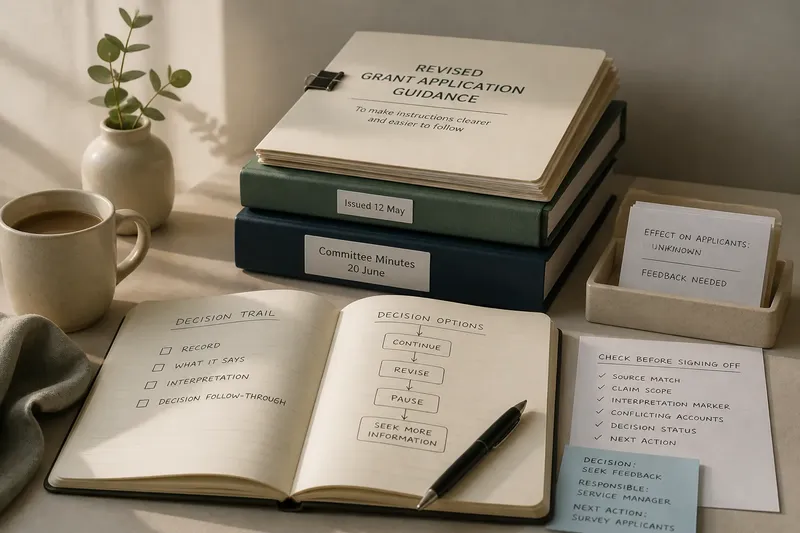
Say you are reviewing a council’s revised grant application guidance. The hypothetical starting records are a published policy saying the revision should make instructions clearer, a dated note confirming that the new guidance was issued, and meeting minutes that contain no account of applicants’ experience. First, record the policy’s stated aim as a statement from that document. Next, record issuance as a completed action supported by the dated note. Then mark the effect on applicants as unknown, rather than interpreting publication as evidence of clearer instructions. Finally, if the minutes record a decision to gather feedback before changing the guidance, note that decision and its stated next action; if they contain no such decision, say that no follow-through appears in the minutes reviewed. The resulting review supports a cautious choice to seek relevant feedback before claiming the aim was met, while leaving open whether the guidance itself should be retained.
What should you check before signing off a review?
- Source match: If each factual claim has a named supporting record, keep it; if not, find a relevant source or mark the claim as unverified.
- Claim scope: If the wording goes beyond what the record establishes, narrow it; otherwise, retain the wording and identify the supporting evidence.
- Interpretation marker: If an assessment is presented as a recorded fact, label it as interpretation; if the distinction is already clear, leave it intact.
- Conflicting accounts: If records differ, describe the disagreement and its implications; if they align on the point, state that cautiously without claiming more than they show.
- Decision status: If a decision is documented, name it and its source; if it is absent, say no decision was located in the material reviewed.
- Next action: If a follow-up is assigned, record the responsible role and action; if none is specified, flag that gap rather than inventing an owner.
What should readers ask about a policy review?
Can meeting minutes prove that a policy worked?
Minutes can document a discussion, resolution or assigned action, depending on what they record. They do not establish the policy’s effect unless they contain relevant evidence about that effect.
What if two records describe an action differently?
Set out both accounts and identify what each source can establish. If the difference matters to the decision, note what would clarify it rather than choosing one account without explanation.
Should a review include recommendations?
It can, provided recommendations are clearly distinguished from recorded decisions. Give the reason for each recommendation and state whether decision-makers have adopted it, if that is known.
How should a missing decision be described?
Specify which records you reviewed and say that they contain no decision on the point. Avoid inferring that no decision was made anywhere unless the evidence supports that broader claim.
How can the review stay useful next year?
Finish with a short record of the decision status: what was agreed, what was recommended but not adopted, and what remains undecided. Attach each point to its source where possible, and make clear who is expected to take any recorded next action.
A strong policy review for the turn of the year does not ask readers to accept a confident verdict. It gives them enough of the evidence-to-decision trail to inspect the reasoning themselves—and enough precision to see exactly where the record stops.